Home to The Money Sham
Real Resource Economics
Breaking Free from Fifty Years of Economic Orthodoxy
In 1945, Beardsley Ruml of the Federal Reserve declared that “taxes for revenue are obsolete”. Keynes said simply: “Whatever we can actually do, we can afford.”
After the Second World War, with public debt above 200% of GDP, Britain created the National Health Service, maintained near full employment, and built hundreds of thousands of affordable homes. The country did not wait to “find the money”. It mobilised people, skills, materials, land, technology and political will.
Seventy years later, after astonishing advances in science and technology, with satellites orbiting the planet and billionaires competing to send rockets into space, we are told that we cannot house ourselves, cannot pay nurses properly, cannot maintain decent public services, and cannot protect people from poverty and insecurity.
Left and right repeat the same fatal phrase: “We would like to help, but we cannot find the money.” The only way progressives get elected is by promising to do nothing that might threaten those who hold power. Once in office they wonder how they became so unpopular. Their response: “tough decisions” had to be made. But tough for whom?
In the 1970s, a cartel quadrupled the price of oil, the energy source on which the post-war economy depended. The resulting inflation gave the old economic doctrines their opportunity to return. The post-war consensus was dismantled. Finance was once again allowed to rule the roost. Economics, shrouded in mathematics and algebra, produced economists and politicians in thrall to “the markets”. Government was declared inefficient and bad. Banking deregulation was sold as liberation. Public spending was denounced as the misuse of “our hard-earned money”.
We have excess and squalor. The solution: somewhere there is a pot of money that can only materialise through economic growth.
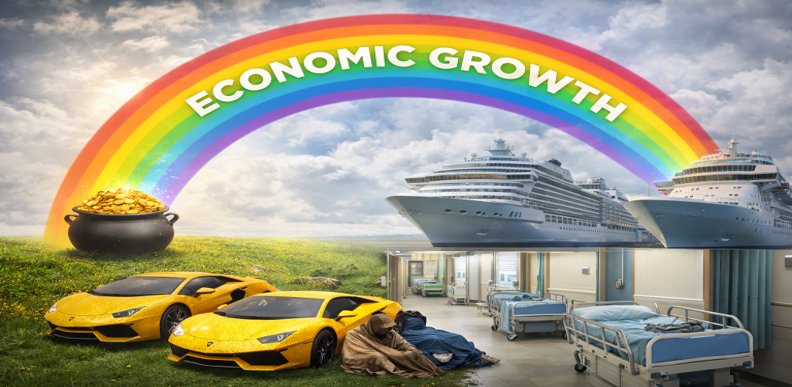
The 2026 OBR assumption is that the government is like a household. It must reduce its debt. We all “know” that government debt burdens our grandchildren. First we must “find the money”; taxes fund spending; bond markets rule elected governments; unemployment is unavoidable; inflation is caused by excessive public spending or excessive wages; private markets, left alone, allocate resources efficiently.
Real Resource Economics explains and rejects these doctrines and asks different questions. It begins with a simple proposition: a country like the UK is not constrained by a shortage of its own money. It is constrained by real resources: people, skills, energy, land, technology, materials, infrastructure, ecological limits and productive capacity.
The questions we should ask are not “Can we afford it?” but:
- Can we do it?
- Do we have the workers, materials, technology and organisation?
- Will government spending raise or reduce inflationary pressure?
- Who gains, and who loses from the mainstream doctrine?
And why do politicians venerate an economic academia which totally failed to see the crash of 2008 and whose forecasts are consistent in being wrong? Why do they disguise regressive policy choices as ones of economic necessity?
Money is a public accounting system, not a commodity or scarce natural resource. Government spending creates financial assets. Taxation removes them. Public debt is benign: it is a record of money already spent; it is the private sector’s net savings. Private bank credit creates much of the purchasing power that drives booms, asset bubbles and crashes.
The purpose of economic policy is not to balance the government’s books. It is to balance the real economy: full employment, stable prices, decent housing, resilient public services, fair distribution, sustainable energy, productive investment and ecological survival.
Real Resource Economics reasserts the post-war lesson: whatever we can actually do, we can afford. See The Money Sham.
The Author
Stephen Laughton has had a non-linear if not eccentric career path, not inappropriate given the non-linear nature of the real economy. With a degree in Philosophy in 1972, he has since been a lifeguard, a teacher, a trade unionist, an employer, while also a rather inefficient mobile mechanic, a playwright, a human resource advisor for airline safety to Volga-Dnieper airline and a cross-cultural language awareness trainer. He gained a Masters in Economics in 2018. In 2023 he helped Mosler with an update to his Soft Currency Economics.
In the 1980s and 90s he was a member of the Full Employment Forum and the Labour Party Economic Policy Group, founded by John Mills, Bryan Gould and Austin Mitchell. He edited Mills’ Britain’s Achilles Heel. He was the political education officer for his Constituency Labour Parties.
As owner of two limited companies, his knowledge of double-entry book-keeping, which is absent from academic economics, helped him to understand money. In 2024 he presented at the first UK MMT conference along with Bill Mitchell, Warren Mosler and Stephanie Kelton.
He remains a philosophical economist, who believes current economic wisdom is deeply flawed and that centrist politicians who follow it are paving the way for their own demise. In The Money Sham he sets out, in plain language, how money actually works in a modern economy, and what becomes possible once we stop confusing financial accounting with real-resource accounting.
Related Work
MMTUK
The concepts within Real Resource Economics are explored in The Money Sham. They are complemented by the work of the MMTUK Policy Research Group; see mmtuk.org for policy papers and briefings.